Specify the price Availability: in stockCondition: warehouse storage
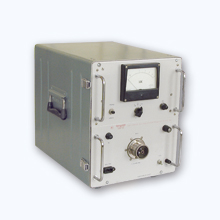
meter M3-3A average power (power meter) - a portable measuring instrument, which is designed to measure the power of high-frequency generators for continuous generation and modulation with rectangular pulses in laboratory and plant conditions. In fact the device is a power meter of the absorbed power, where power meter - power meter, power meter and power absorbed - measures the absorbed power (in addition to the incident) because of design features. & nbsp;
The device used in laboratory conditions, control and repair plants and has the following working operation climatic conditions: ambient temperature from 0 to +40 ° C, relative humidity 80% at 20 ° C. Operation of the unit in conditions other than workers, are not allowed. & nbsp;
The device is mounted on a vertical panel and a horizontal dural steel chassis and enclosed in a steel casing to which the panel is fastened with four screws. The case has a hinged carrying handle device. The front panel contains the following controls: a dial gauge, controlled range switch B3 ( "scale"), setting the ZERO potentiometer, pushbutton zero control switch ( "BIT"), for switching on the switch holder indicator lamp, the fuse holder (aka switch voltage) input jack to sum the measured high-frequency power, and ground terminal block for connection to the network. Along the edges of the front panel reinforced Handles. & nbsp;
Before you start working with the instrument M3-3A, you must carefully examine the technical description and operating instructions. & nbsp;
Preparing for use: & nbsp; 1) If the unit is first turned on, before turning to check the adjustment knob to zero, check the switches and protection serviceability. & nbsp; & nbsp; 2) Before the operation of the appliance in the network must: & nbsp; A) to ground the appliance body; & nbsp; B) switch to turn the power supply "OFF" position; & nbsp; B) to switch the unit to the desired line voltage; & nbsp; D) power cord accorded to the device, connect to the device and turn on the supply network. & nbsp; & nbsp; 3) toggle switch on the appliance connected to the mains. This should illuminate indicator light; & nbsp; 4) in 3-5 minutes after the pen to put the arrow zeroing the meter to zero. Then the instrument is ready for measurement. & nbsp;
Measuring instrument: & nbsp; 1) Put the switch scales to the desired position. If the approximate value of the power measured is unknown, it is necessary to start from a scale of 15 W, as measured in a continuous mode and generating from the 5000 watts scale in the measurement of pulse power; & nbsp; 2) the measured power directly with the feed input of the device or through a connecting cable and a high frequency to produce a reading on the relevant scale. Before each measurement should be checked and, if necessary, set the zero of the device; & nbsp; 3) To determine the measured power values is multiplied by a reading device correction and frequency correction factor. & nbsp;
The principle of the power meter M3-3A consists of a voltage measurement at a known resistance, which serves for the test load power source. & nbsp;
SPECIFICATIONS & nbsp;
Performance
Values
Operating frequency range
30 - 1200MHz
power measurement range:
during continuous generation of scales on 1,5NG and 15NG;
from 0.25 to 15 W
during pulse modulation (not higher than 15 W for the average power) on the scales 50, 500, 5000.
from 5 to 5000 W
Basic error power measurement when measured directly at the input of the device (excluding mismatch error) no more than:
< center> when measured baseband power fluctuations on a scale 1.5W
± 15%
power measurement unmodulated vibrations on the scale 15 W
± 20%
when measured pulse power
± 25%
Additional error power measurement does not exceed the following values:
when changing the line voltage of 400 Hz (115 ± 5,75) in
not more than ± 3,5%
at ambient temperature changes from the normal at every 10 ° C
not more than ± 5%
Deviation grading scales power meter at a frequency of 50 Hz from the measured value
not more than ± 7%
Deviation wattmeter due duty cycle RF pulses for the repetition frequency from 100 to 5000 Hz with pulses with a duration of at least 2 microseconds (duty ratio of 100 - 5000)